Wednesday, May 13, 2015

Space and Time


Thoughts on space and time 
By Jimmy Henderson (MA psychology) FRC


As far back as 1787, the philosopher Immanuel Kant expressed his belief that space and time were not scientific absolutes, but rather ‘categories’ of the human mind which allow us to structure and manage reality. 

Recent thinking in quantum physics supports this view by also suggesting that both time and space are mental formulations which provide us with the framework within which to come to some understanding of the workings of the universe. In other words, they are relative to the thinking and perception of the observer.

This can be proven by applying a simple observation. Imagine a situation where two friends are parting after a meeting. As the one friend moves further away, he eventually reaches a position where he can no longer be seen by his friend. However, from another vantage point a few hundred meters above the ground, both friends are still clearly visible, although they are already a few kilometers apart. 

If taken to the extreme, this experiment suggests that to a person with an infinite view (an extremely high consciousness), nothing is ever out of sight and the concept of space (distance) is therefore relative to the depth of our perception.

‘for us physicists believe the separation between past, present, and future is only an illusion, although a convincing one.’
Albert Einstein

In a similar manner, time-measurements are also relative. According to Einstein’s Theory of Relativity, our sense of time is determined by our speed of movement, in this case, the movement of the Earth relative to the Sun and the stars. In other words, if we were travelling in space at extremely high velocities, possibly exceeding the speed of light, our experience of time would be different.

This time-relativity can be experienced when dreaming, in which an event which seems to last only a few minutes in a dream ends up being a half-hour in real time. This also implies that our experiences of time and space are linked to our states of consciousness. In other words, anything that is being processed three-dimensionally and sequentially by our minds would automatically include the perception of space and time. 

This also means that if we were able to view the world holographically (multi-dimensionally) our experiences may be different. In recent years most of us have noticed how time seems to have speeded up, which suggests once again, that time and space are relative to our perception. 


Jimmy Henderson is a cognitive researcher and metaphysician and a published author of books on self-development and the power of the mind. His books are available on Amazon.com 
http://www.amazon.com/s/ref=nb_sb_ss_c_0_15?url=search-alias%3Dstripbooks&field-keywords=jimmy+henderson&sprefix=jimmy+henderson%2Caps%2C427 as well as his website www.jimmyhendersonbooks.com 

Tuesday, May 5, 2015

The many faces of God


 The many faces of God
       Jimmy Henderson FRC

‘And the angel said unto me, ‘be gentle with my children’ (do not cause them to stumble in their beliefs)’
J. Henderson

The rise and fall of religions and spiritual practices in different cultures and societies through the ages could also be mirroring the changes and shifts taking place within the God-Mind.

If we look carefully, we will see that we form different concepts of God at various times in history. This could be due to the fact that different universal archetypes exist in the Mind of God which all represent Godhead in some way or another. For example, the earliest religions consisted of the worship of spirits which were said to animate mountains, trees and rivers, and natural phenomena were believed to be the result of their activities.

Later, a series of polytheistic religions emerged, such as that of the ancient Egyptians, Greeks, Romans and Aryans. This was a shift away from an almost infinite amount of elemental godlike sub-personalities to a definite number of gods or deities. In terms of our study of the mind, it is quite possible that these were all archetypal sub-personalities of the God-Mind which presented themselves during trance-like states induced by religious rituals.

It may also be true that polytheism emerged at a time in history when our minds were still unable to imagine a single divine being having so many different powers, aspects and attributes, and the idea of a single God became acceptable later with the further development of language and more complex understandings of God became possible.

In other words, our ideas of God are, once again, linked to the development of our minds and language, which allow us to understand deeper truths, and no concept of God can ever be said to be ‘wrong’ in the true sense of the word.

Conscience is the highest religion’
J . Henderson


 Jimmy Henderson is a mystic with an extensive academic background. He is able to combine psychology and philosophy with metaphysics in order to present credible information on man's relation to Spirit. His books are available through local bookshops as well as Amazon.com (key in 'Jimmy Henderson' under 'books')                         

Tuesday, April 14, 2015

Public Talk at Theosophical society


Talk on dreams

My next talk is with the Theosophical society
Theosophical Society in Southern Africa
Durban Lodge PBO 050-950
306 Avondale Road, Morningside, Durban
All Public Meetings start at 10 am at the Lodge - first Sunday of each month
Enquiries: 073 585 4856 / Lodge President: Pamela Passmore
Admission: FREE
Sunday – 3 May Title: ‘Dream Interpretation’
Speaker: Jimmy Henderson
The importance of dreams will be discussed as well as their hidden meanings and symbolism, and what the subconscious is trying to tell us. This includes recalling and interpreting your dreams and looking at their different dimensions.
Most importantly, Jimmy will introduce the special category of lucid dreams in which we open ourselves to spiritual initiations as well as messages and guidance from Spirit. You will be shown how to control these lucid dreams, which will greatly assist in the development of your mental and psychic skills.
ABOUT THE SPEAKER:
Jimmy Henderson is a high-degree Rosicrucian and published author of metaphysical self-development books. He is busy with his PHD in cognitive psychology and is considered an expert of the workings and powers of the subconscious mind. www.jimmyhendersonbooks.com

Tuesday, April 7, 2015

          A conversation with death
                               By Jimmy Henderson 
\                              
    Hons (phil) PH.D(psychology) 

   It was early in the morning when I imagined myself approaching the Angel of Death and beginning to question him. ‘Sir’, I said, ‘I really need to ask you a number of important questions, perhaps you can help me’. ‘Are you really able to swallow up complete human lives, the collective history of mankind, so many memories and a level of self-consciousness which has evolved over millions of years?’ ‘Are we really supposed to accept that we are born, and live, love and laugh merely to pass away forever into some sort of oblivion?’
   ‘I suppose it depends on what you mean by oblivion’, he said.
   I told him that it seemed unreasonable to suppose that a highly-developed principle such as Life, evolving in different forms for millions of years, eventually expressing in a sentient human being, would simply allow itself to be extinguished forever in a few short decades. ‘I mean’, I said to him, ‘would you willingly participate in any drama that you knew was ill-fated and would leave you with nowhere to go?’ ‘Is it logical for an evolving process such as Life to continue along a route that will lead it to a point of nothingness?’
   He laughed. ‘Are you not confusing your own mortality with the universal process of life?’ he said.
    ‘That is my point exactly’, I replied, ‘A universal process’. ‘People die, but life continues’. ‘Is Life therefore not eternal?’
   I was not making much progress, but I continued to argue the point. My peace of mind was at stake and it was too important for me not to use this opportunity to speak directly to him. 
   ‘And what of evolution?’ I asked him.
   ‘What of it?’ he replied.
   ‘Why would the many forms of Life continue to evolve at all, if it was all destined to end abruptly?’
   He laughed and said that I had a good point! But then he quietly continued by saying, ‘Perhaps, like you, Life simply does not know what Death is and stupidly stumbles on producing human beings for no real reason at all’.
   ‘That is not logical’, I said, ‘We know that life develops in its many forms’. ‘It simply doesn’t make sense that Life would evolve towards a point where it would eventually cease to be’.
   ‘Do you doubt that you die?’ He asked.
   ‘Death is not my concern’, I said to him, ‘the question is whether it all ends at death’. ‘Do I really fall off the edge of the universe into a black hole with the power to swallow up space, time and my own memory of myself?’
   What happens to that memory, our identity?’ I asked. ‘If death is able to dissolve our knowledge of ourselves, how is it that we are now, at all times, still able to remember who and what we are, as a child, an adult, during sleep, when dreaming and once we awaken again?’
   He smiled, but did not reply, so I continued.
   ‘And if we are still evolving’, I said, ‘as we are led to believe, then we are at present still less than perfect?’
   ‘That does make sense’, he said.
   ‘Then surely we have, sometime in the future, still to be perfected, otherwise all talk of development would be pointless?’ I replied.
   ‘Once again you confuse yourself as an individual, with the larger process of Life’. ‘It is the process that renews itself’, the angel replied.
   ‘If the process is continually renewing itself’, I said, ‘then it must be eternal’.  ‘And if life is eternal, surely I still can still continue to exist in some way or other?’
   I now began to question the mystery even more deeply, reaching into the very structure of the human mind and the processes underlying our thoughts, for that one self-evident truth that would prove, beyond any doubt, that our consciousness continues after death, something that we have missed, in its fleeting moment of truth. The philosopher Descartes had followed this same path many centuries ago, deducing our very real existence from a single realisation, ‘I think, therefore I am’.
   ‘Perhaps’, I surmised, ‘I could build on this and prove to myself, ‘I am self-aware, therefore I must continue to exist after death’. With this thought, I faced up to the angel of Death once again.
   ‘In our understanding of science’, I said to him, ‘it is a proven fact that a lamp will not light up unless the entire circuit is complete.’
   He nodded.
   ‘Likewise, could we, as human beings, have ever reached a point of self-awareness if our consciousness were not part of a completed circuit or eternal cycle?’
‘Explain yourself further.’ he replied.
   ‘Would not the permanent ending of our consciousness at death have rendered our present state of self-awareness impossible?’ I said. ‘Surely our present self-awareness must be linked to some future continuity, the completion of a circuit of consciousness which enables us to look forward and backwards in continuous self-reflection?’ ‘And is this self-reflection not our present self-awareness?’
   At first he was very quiet. Then he asked a question;
   ‘If your Life continues’ he said, ‘what would be my role as the angel of Death?’
   ‘Perhaps you are a facilitator!’ I retorted.
    He liked that remark and laughed out loud.
   I continued. ‘Perhaps your purpose is to guide us into this eternal, more perfected form of Life?’
   He challenged me. ‘And what is this more perfect form of Life of which you speak?’
‘During sleep I dream, and my consciousness remains intact’, I replied, ‘will I not dream after death?’
   ‘Perhaps this life is the dream’, he said. ‘Do you like to dream?’
   ‘If I were to dream after death’, I said, ‘then I would have to be alive in some way, for in order to dream we must still exist’.
   He did not reply
   What then, is death?’ I said, ‘The end of one dream or the beginning of a new one?’
   He left without answering. 


Monday, March 16, 2015

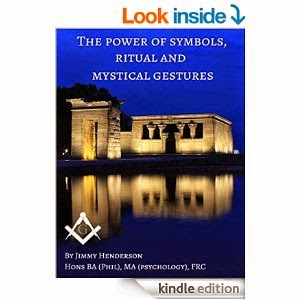
The power of ritual -extract from new e-book available on Amazon.com and Smashwords

               
The power of ritual

By Jimmy Henderson FRC 

When considering the power of ritual, it will be seen that symbols, symbolic images and actions form the basis of ritualistic ceremonies, which could really be said to be dramatizations (similar to a play), in which great truths concerning man, soul, God and reality are presented.

As in the case of a screenplay, each ritual has a ‘script’ as well as a number of different ‘dimensions’ in which the sacred truths and symbolic messages are concealed.

These dimensions include the actual setting up of the ritual, such as the backdrop, layout, lighting, positioning of the furniture or props and the background music. All these have a symbolic meaning and normally set the context for the ritual.

For example, the effective use of appropriate furniture, lighting and music is a powerful tool in creating a certain ambiance of dignity and respect which prepares the participants mentally and emotionally to respond to subliminal messages or impressions and to assimilate new inner experiences. Subliminal messages framed by the setting could include: ‘This is a sacred place’; ‘This is a place of learning’; or; ‘This is an important ritual’. Whether or not participants actually notice these messages will depend on their openness and readiness, which will be discussed later.

The second dimension comprises of the actual characters (office-bearers) in the ritual. Each person has a symbolic role, also full of meaning. Once again, the dress and regalia of each office-bearer conveys a certain message and contributes to the overall theme and significance of the ritual.     

The third dimension, which is very important, is the activities which take place. These activities embody the ‘script’ that is being enacted and each scene, movement and gesture would present an important symbolic message which has to be interpreted metaphorically. For instance, being called to enter via a portal or doorway would imply that a decision has to be made (whether to enter or not) and suggests that the member may (symbolically) be entering a higher level of knowledge or purity.

Each action, such as the summoning of a candidate or making him (or her) move in a specific direction, would also have a deeper metaphorical meaning. For example, a gesture to enter a room or specific area of the temple could symbolically imply an invitation to enter into a higher level of knowledge or illumination. During initiations or installations, a change in the dress or sitting position of the candidate could also symbolically denote a change in the candidate’s status.
During the ritual, each observer or participant should be asking himself (or herself) what the symbolic meaning of this particular activity is, and how it affects him/her emotionally and psychologically. In this way the ritual creates an opportunity for reflection and introspection, and for all present to benefit intellectually and spiritually from what is being enacted or conveyed. Once again, whether this actually happens, depends on the participation and state of mind of the member concerned. .

The final dimension of the ritual is comprised of the symbolic objects or props that are used. Once again, each has a special meaning which adds to the overall message of the enactment. These meanings can usually be gleaned by applying metaphors to their everyday use.

For example, a candle would be a symbol of light (illumination in the darkness of ignorance), and a ceremonial sword a symbol of power and authority (it has the power to subdue others).

 The true power of ritual therefore relates to its ability to bring about changes in our emotional and psychological experience with a view to creating a readiness to receive impressions and communications from the subconscious mind or even the God-Mind. Normally, a special  level of ‘mindfulness’ is required for this, such as occurs during meditation, an altered state of consciousness in which our thinking is quieted, our brainwave patterns slowed down, and we open direct channels to the subconscious mind. This in turn, can lead to clearing of the pathway to the God-mind and spiritual knowledge being more easily communicated.

However, the solemnity, dedication, focus, activities and symbolism of the ritual are such that it can also produce a similar conscious state, one which also allows for the opening of the subconscious mind and the transfer of inspired thoughts and hidden truths.

The aim of ritual is therefore to prime our minds for the inflow of sacred knowledge and divine illumination. As mentioned, this requires a certain state of readiness in which the mind has been gradually prepared through guided studies and discipline, as would be provided by fraternal organisations based on the ancient mystery schools such as the Freemasons and Rosicrucians which offer graded teachings with structured degrees of learning having a high moral and spiritual basis.

Jimmy Henderson (MA Psychology) FRC, is a Rosicrucian and cognitive specialist who has published many books and articles on metaphysical subjects. His psychological approach makes the  information all the more credible. See Amazon.com (Jimmy Henderson) for a list of his books. 


Saturday, February 21, 2015

Many beliefs, one reality


Many beliefs -one reality 

By Jimmy Henderson FRC

We are daily faced with the paradox of so many different religions and belief systems which all lay claim to the truth. Yet if we accept the idea of a single reality, this paradox can be explained in terms of a metaphor in which, what each of us, either as individuals or groups, see or understand of the world, can be seen to be only different pieces and shades of cloth cut from one universal fabric.

Perhaps I can explain this better by also using the analogy of a puzzle. If we present a 3000 piece, complicated cardboard puzzle to a group of small children, due to their immaturity, inexperience and limited ability to reason, it is unlikely that they could ever complete it. However, if we separate the puzzle into much smaller pieces and give each child a section to complete on his or her own, be it a corner, a border or a certain patch of colour, it is quite possible that they will all be successful in putting together their small sections. And later, as long as they agree to work together and combine their different sections, the entire puzzle will take form.


This analogy implies that each school of scientific, psychological, philosophical or religious thought in the world today could be said to be holding a small piece of the great puzzle of reality and have at least some answers to the mysteries of life and the existence of mankind and the universe. However, the problem at present is that each group believe that their small section is the completed puzzle and are prepared to vigorously defend their views. This leads to the ongoing arguments and strife we see in the world as to who is right and who is wrong. The groups are all unable to see that what they each have is only a small part of a universal, many-faceted and multi-layered explanation of Mind and reality. 

Jimmy Henderson is a cognitive scientist and metaphysician, His books are available on Amazon.com (Jimmy Henderson) or through his website www.jimmyhendersonbooks.com 

Wednesday, January 28, 2015

The law of attraction


The law of attraction and the self-fulfilling prophecy

Jimmy Henderson (MA psychology, FRC)

It is often believed that our thoughts can attract favourable or unfavourable life-experiences and circumstances into our lives. This idea is given a mystical or magical tone in many spiritual publications. However, this can also be explained in psychology as a ‘self-fulfilling prophecy’, which occurs when our beliefs (especially about ourselves), result in attitudes and actions which draw us precisely to those things we desperately seek to avoid.


For example, consider a young man who was humiliated by his friends as a child and entered adulthood with major insecurities. He will now, in all likelihood, entertain ideas such as ‘I am not popular’, ‘I never get invited to parties, ‘I may just as well stay home’, and so on. The problem is that these beliefs eventually filter into his subconscious and become ‘schemas’ or ‘scripts’ which shape his social behavior. In other words, as a result of these beliefs, he now projects a total lack of self-confidence and is unwilling to involve himself in social activities. This is noticed by others (especially women), who eventually start to disengage from him and he is no longer invited to social events, which only further reinforces his deeply-held belief that he is unpopular. His negative beliefs about himself have now become a self-fulfilling-prophecy.


Fortunately, this same type of programming, if used correctly, can become positive and help to manifest one’s desired reality. In other words, it is partially true that we can improve our chances for success simply by removing our negative self-beliefs, but it is probably a bit more complicated than this, as there are always other factors involved that need attention, such as our personalities, attitudes, and motivations, as well as the realities of our personal, home and work situations. 

Jimmy Henderson is a cognitive scientiist and metaphysician who combines psychological research with metaphysical principles. His books are available on Amazon.com or through his website www.jimmyhendersonbooks.com